Two-Car Garage Size Guide: Standard Dimensions, Minimum Space, and Smart Layouts
A two-car garage can mean very different things depending on the size. A 20×20 garage may fit two small cars, but it will feel tight. A 24×24 gives you more room to open doors and move around. A 24×30 or larger can handle parking, storage, and a workbench without making the space feel crowded.
This guide explains standard two-car garage dimensions, minimum two-car garage size, garage door options, common layouts, and how to choose the right size for your vehicles, storage needs, and property.
Table of Contents
What Counts as a Two-Car Garage?
A two-car garage is any garage wide enough to park two vehicles side by side. Most two-car garages start around 20 feet wide and 20 feet deep, or 400 square feet. Larger two-car garages can be 24×30, 24×36, 28×32, or even larger if you want extra storage or workshop space.
Garage dimensions are usually listed as width x depth. For example, a 24×24 garage is 24 feet wide and 24 feet deep, giving you 576 square feet. A 24×36 garage has the same width, but adds 12 more feet of depth for storage, tools, a workbench, or equipment behind the vehicles.
The right two-car garage size depends on what you drive and how you plan to use the space.
Standard Two-Car Garage Dimensions
There is no single standard two-car garage size, but a few sizes are common for homeowners. The main difference is how much space you want around the vehicles and whether the garage will also be used for storage or work.
20x20 Two-Car Garage: Minimum Size
A 20×20 garage gives you 400 square feet. This is usually considered the minimum size for a two-car garage.
It can work for two compact cars or smaller mid-size vehicles. But the space will be tight. Each vehicle gets about 10 feet of width. Since many vehicles are 6.5 to 7 feet wide, that does not leave much room for open doors, walking space, or wall storage.
A 20-foot depth works for many passenger cars, but it may not be enough for larger SUVs or full-size trucks. If your vehicle is 18 to 20 feet long, you may have little to no room left behind the bumper.
A 20×20 garage is best when space or budget is limited. If you want storage, a workbench, or room for larger vehicles, it is usually worth sizing up.
24x24 Two-Car Garage: Common Standard Size
A 24×24 garage gives you 576 square feet and is one of the most common two-car garage sizes.
Compared to a 20×20, the extra width makes a big difference. You have more room to open doors, walk between vehicles, and use wall space for basic storage. For many homeowners, 24×24 is the first size that feels like a comfortable daily-use two-car garage.
A 24-foot depth also gives you more room behind the vehicles. You may be able to add shelves, hooks, or a small workbench along the back wall, depending on the length of your vehicles.
For two cars, crossovers, or mid-size SUVs, 24×24 is a strong starting point.
24x30 Two-Car Garage: More Room for Storage
A 24×30 garage gives you 720 square feet. This size works well for homeowners who want two-car parking plus usable storage space.
The width stays comfortable for two vehicles, while the extra depth gives you room behind the cars. That rear area can hold a workbench, tool chest, chest freezer, lawn equipment, storage bins, or wall-mounted shelving.
For many homeowners, 24×30 is the first size that lets the garage do more than just park cars. It gives you room for daily parking and still leaves space for the things that usually end up in a garage.
24x36 and Larger: Parking Plus Workshop Space
A 24×36 garage gives you 864 square feet. At this size, you can park two vehicles and still have a clear workspace behind them.
This layout works well for homeowners who want a serious storage area, hobby space, or workshop. You can add a larger workbench, tool storage, lumber rack, mower storage, or other equipment without giving up both parking spaces.
Larger sizes, such as 24×40, 24×48, 28×32, 28×40, and 28×48, give you even more flexibility. Wider garages are especially helpful if you drive trucks or large SUVs. Deeper garages are better if you want a workshop, boat storage, equipment storage, or extra room behind the vehicles.
Two-Car Garage Size Chart
| Size | Sq. Ft. | Best For | Notes |
| 20×20 | 400 | Tight two-car parking | Minimum size; limited door clearance and little storage |
| 20×24 | 480 | Two compact cars plus basic storage | More depth, but width is still tight |
| 20×28 | 560 | Two cars plus small work area | Better rear space; width may still feel narrow |
| 20×32 | 640 | Two cars plus workshop space | Good depth, but 20-foot width limits comfort |
| 24×24 | 576 | Standard two-car parking | Common size; good for many homeowners |
| 24×36 | 864 | Two cars plus storage or work area | More room behind vehicles |
| 24×40 | 960 | Two cars plus dedicated workspace | Good for hobbies, tools, or shop use |
| 24×48 | 1,152 | Two cars plus large storage or boat | Useful for deep storage or equipment |
| 28×32 | 896 | Two large vehicles plus storage | Extra width helps with trucks and SUVs |
| 28×40 | 1,120 | Two large vehicles plus full shop | Strong choice for parking and workspace |
| 28×48 | 1,344 | Large vehicles, boats, or full shop | Best for maximum storage and work space |
How Much Clearance Do You Need?
A garage may look large enough by square footage, but clearance is what makes it comfortable to use. When choosing two-car garage dimensions, think about door swing, walking space, side wall clearance, and room behind the vehicles.
Door Swing
Most car doors need about 2.5 to 3.5 feet of space to open comfortably. Larger trucks and SUVs may need closer to 4 feet.
In a 20-foot-wide garage, two vehicles can fit side by side, but the space between them is limited. You may have to open the door only partway and turn sideways to get out.
A 24-foot-wide garage gives you more room between vehicles and along the side walls. If you drive two large vehicles, a 28-foot-wide garage may be the better choice.
Space Behind the Vehicles
Depth is just as important as width. Many cars are 14 to 16 feet long. Full-size SUVs and pickup trucks can be 18 to 21 feet long, and some crew cab trucks are even longer.
If your garage is 20 feet deep and your vehicle is 18 feet long, there is very little room left at the back. A 24-foot-deep garage gives you more space for walking, shelves, or a small workbench. A 30-foot-deep garage gives you a separate rear zone for storage or workspace.
Side Wall Clearance
Try to leave at least 18 to 24 inches between each vehicle and the side wall. This gives you room to walk, open doors, reach storage, and move around the garage without squeezing past the vehicle.
If you want shelving, hooks, trash cans, bikes, or lawn equipment along the side walls, plan for more space.
Garage Door Sizing for a Two-Car Garage
Most two-car garages use either one wide double garage door or two separate single garage doors.
16-Foot Double Garage Door
A 16-foot double garage door is a common choice for a two-car garage. It gives you one wide opening for both vehicles and works with many garage layouts.
A 16-foot door can fit on a 20-foot-wide garage, but the space near the sides will be tighter. On a 24-foot-wide garage, the door has more room around it, and the layout feels more balanced.
Two 9-Foot Single Garage Doors
Another option is to use two separate 9-foot garage doors. This gives each vehicle its own opening. It also allows you to open one side without opening the entire garage.
Two separate doors usually work best with a 24-foot-wide garage or larger. The center post between the doors adds structure, but it also means each driver needs to line up with their own door.
Both options can work. A double door gives you one large opening. Two single doors give you a more separated layout.
Permit and Foundation Considerations
Most two-car garages require a building permit. Exact rules depend on your state, county, township, city, or HOA.
Many local building departments require permits for accessory structures over 200 to 256 square feet. Since even a small two-car garage is usually 400 square feet or more, you should expect to check local permit rules before ordering.
Common permit requirements may include:
- Setbacks from property lines
- Site plan
- Foundation details
- Garage size and height
- Stormwater or drainage rules
- HOA approval, if applicable
Setbacks are especially important. A garage that is too close to a property line may not be approved, even if the building itself is well made. Always confirm local setback requirements before choosing the final footprint.
Foundation Options
A two-car garage needs a proper foundation. The best foundation depends on the size of the garage, the site, and local code requirements.
Many two-car garages are placed on a concrete slab or a concrete perimeter foundation. Larger garages, especially 24×36 and above, often need a poured concrete slab for strength, stability, and permit compliance.
In colder states such as Pennsylvania and New York, frost depth also matters. Footings may need to extend below the frost line to help prevent shifting, cracking, or heaving during winter. Your local building office or foundation contractor can confirm the required depth for your area.
Two-Car Garage Layouts for Different Uses
The best two-car garage layout depends on how you plan to use the space. A garage used only for parking does not need the same dimensions as a garage used for storage, tools, or workshop space.
Two Cars Only
If the garage is mainly for parking, a 24×24 is a good starting point. It gives you enough room for two vehicles and some basic wall storage.
A 20×24 may work if both vehicles are compact, but the width will still feel tighter. If you have mid-size SUVs, trucks, or growing storage needs, 24 feet of width is usually more comfortable.
Two Cars Plus Storage
If you want to park two cars and still store everyday items, look at 24×30 or 24×36.
These sizes give you room for shelves, bikes, lawn equipment, tools, a freezer, storage bins, or seasonal items. The extra depth helps keep storage behind the vehicles instead of crowding the parking area.
Two Cars Plus Workshop
For a garage with a real workshop, consider 24×40, 28×32, or larger.
This gives you space to separate parking from the work area. You can keep tools, benches, project materials, or equipment set up without having to move everything every time you park.
If you work with lumber, large tools, or equipment, extra depth and width will make the garage much easier to use.
Trucks and Large SUVs
Full-size trucks and large SUVs need more room than compact cars. Many full-size pickups are 19 to 21 feet long and around 6.5 to 7 feet wide, not including mirrors. Crew cab trucks with longer beds may need even more depth.
For two trucks, a 24-foot width may work, but 28 feet is more comfortable. Plan for at least 24 feet of depth, and consider 30 feet or more if you want room behind the vehicles.
A 28×32 or 28×36 garage is often a better fit for two large vehicles plus storage.
Two-Car Garage Sizes We Build
Our double-wide prefab garages are built for homeowners who need more than a basic one-car structure. They work well for two-car parking, storage, tools, equipment, hobby space, or workshop use.
Available two-car garage sizes include:
- 20×20, 20×24, 20×28, 20×32
- 24×20, 24×24, 24×36, 24×40, 24×48
- 28×32, 28×36, 28×40, 28×48
We offer two main double-wide garage styles.
Mega Double Wide Garage
The Mega Double Wide Garage is a single-story prefab garage with an open floor plan. It is a good option if you want maximum floor space for vehicles, storage, tools, equipment, or a workshop.
The open interior also gives you flexibility for taller vehicles, overhead storage, and different layout options.
2-Story Double Wide Gambrel Garage
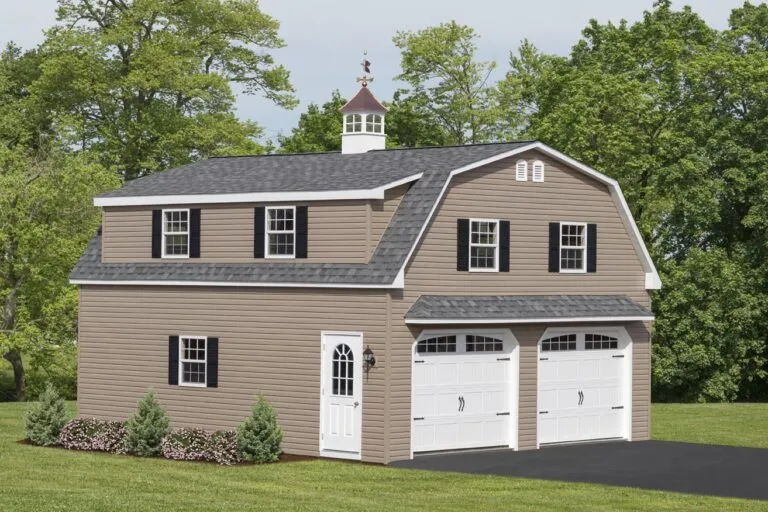
The 2-Story Double Wide Gambrel Garage includes a full upper loft. This gives you additional enclosed storage or workspace above the parking area without increasing the garage footprint.
This style is a good choice if you want to keep vehicles below and move storage, seasonal items, or hobby space upstairs.
Custom dimensions are also available. If one of the standard sizes does not fit your lot, vehicle needs, or local permit requirements, contact us and we can help you work through the options.
Frequently Asked Questions
What is the standard 2 car garage size?
A common standard 2 car garage size is 24×24, or 576 square feet. This size works well for many homeowners because it gives two vehicles room to park side by side with enough space to open doors and add basic storage.
For trucks, large SUVs, or more storage, 24×30 or 24×36 may be a better starting point.
What is the minimum size for a 2-car garage?
The minimum practical size for a 2-car garage is usually 20×20, or 400 square feet. This can fit two compact cars, but it will be tight.
If the garage will be used every day, or if you want room for larger vehicles and storage, a 24-foot-wide garage is usually more comfortable.
How wide should a 2-car garage door be?
A standard two-car garage door is usually 16 feet wide. Another option is to use two separate 9-foot-wide garage doors.
A 16-foot double door gives you one wide opening. Two 9-foot doors give each vehicle its own opening. Both options are common, but two separate doors usually need a wider garage wall to fit well.
How many square feet is a 2-car garage?
A two-car garage can range from 400 square feet to more than 1,300 square feet, depending on the size.
Common examples include:
- 20×20: 400 sq. ft.
- 24×24: 576 sq. ft.
- 24×36: 864 sq. ft.
- 28×40: 1,120 sq. ft.
The right square footage depends on your vehicles, storage needs, and whether the garage will also be used as a workspace.
Can a 2-car garage fit two trucks?
Yes, a two-car garage can fit two trucks if the dimensions are large enough. For two full-size trucks, 28 feet of width is usually more comfortable than 24 feet.
For depth, plan for at least 24 feet. If the trucks are long crew cab models or you want storage behind them, consider 30 feet of depth or more.
Do I need a permit for a 2-car garage?
In most areas, yes. Most two-car garages are large enough to require a building permit.
Permit rules vary by location, so check with your local building or zoning department before ordering. You may need to confirm setbacks, foundation requirements, garage height, drainage rules, and HOA restrictions.
Ready to Build?
Browse our double-wide prefab garages or contact us to discuss a custom size. We deliver and install across New York and Pennsylvania, and our team can help you choose a garage size based on your vehicles, property, storage needs, and local permit requirements.
Request a quote through our contact page or call us directly to talk through your options.
Ready to Start Your Project?
"*" indicates required fields